Sacred Flight
Last and First MenSacred Flight was the First Men’s religious practice of flying as worship: aviation served ordinary communication, but its speed and danger also made it the faith’s most exalted expression of motion. From a birth ceremony to mass aerial displays, flight organized individual milestones and public spectacle alike, binding a society devoted to activity through rituals performed in the sky.
Religious Meaning and Social Place
The practice followed from the First Men’s worship of Gordelpus, the god of motion. Their creed demanded swift and intricate activity, and promised eternal preservation in Gordelpus’s spirit to those who justified themselves through action. Flight held a distinctive place in this order: it was practically important as a means of communication, yet as the swiftest form of locomotion it was also treated as the highest act of worship.
The aeroplane carried an additional religious association because its form recalled the principal symbol of ancient Christianity. Although the old faith’s spirit had been lost, some of its symbols survived within the new religion. More immediately, in a society where warfare had disappeared, dangerous aviation gave an outlet to the human appetite for adventure. Young people risked their lives in devotion to Gordelpus and in hope of salvation, while older spectators took vicarious pleasure in their displays.
Public Rites and Aerial Displays
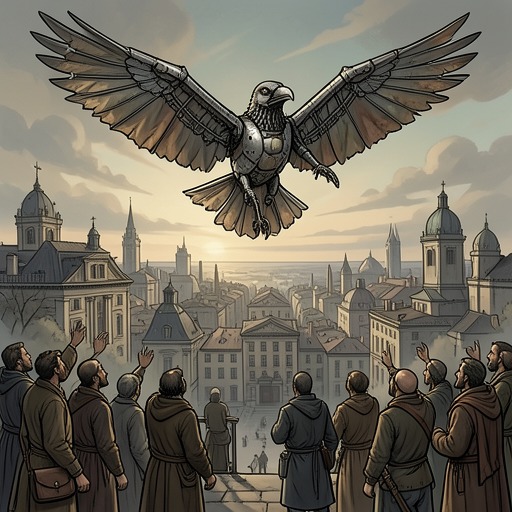
On the frequent Days of Sacred Flight, religious centres held communal and individual flying rituals. Thousands of planes filled the sky in coordinated patterns, wheeling, tumbling, soaring, and plunging at different altitudes. The movements at each level complemented those above and below, making the display a single, intricate aerial dance. After the mass formation suddenly dispersed, celebrated fliers performed in quartets, pairs, and solos.
The ceremonies continued after dark. Planes carrying coloured lights traced changing symbolic patterns across the sky. For eight centuries, another recurring observance had used a dense formation extending six thousand miles to spell out the sacred teachings of Gordelpus in a message meant to be visible at a distance. Sacred Flight thus made doctrine a public spectacle: the faith was not only taught but inscribed in motion above the community.
Flight Across an Individual Life
Flight was incorporated into life from its beginning. In the birth ritual, a priestess of flight lifted the newborn and released the infant with a parachute, to be caught on the wings of the father’s plane. This dangerous custom served as a substitute for contraception, which the religion prohibited as an interference with divine energy; many infants could not maintain their grip and died. The ritual made the doctrine of movement a literal condition of entry into the community.
At adolescence, each person took charge of an aircraft for the first time, and later life was marked by demanding aeronautical tests. Passing the test known as Wing-Winning could establish legal maturity as early as fifteen, while some did not attain it until forty. Those who failed at that age remained excluded from sexual activity and knowledge. From middle age onward, when advancement in the hierarchy of active flight was no longer expected, people continued to fly each day for practical purposes. The aircraft therefore marked not one isolated rite but a progression from birth through adulthood and into old age.
Faith, Discipline, and Collective Unity
Sacred Flight joined spectacle to social discipline. Flight, dancing, and athletics were all religiously imposed forms of activity, and professional fliers and aeronautical engineers belonged to a privileged class. At the same time, the faith regulated other instincts according to its hierarchy of sacred conduct. Sexual knowledge and activity were restricted until Wing-Winning, and even dances whose significance could be read sexually were officially interpreted in metaphysical terms. The rite of flight consequently served as both an act of devotion and a threshold within a tightly governed social order.
The aerial festivals also helped preserve peace and unity. Their scale and coordination made collective order visible, while their risks offered a substitute for the adventurousness that warfare might otherwise have claimed. Sacred Flight’s central contradiction lies in this fusion: an intensely hazardous pursuit was organized as a disciplined civic ritual. It turned individual daring into a patterned public performance and made the movement of aircraft stand for the movement of the whole society.